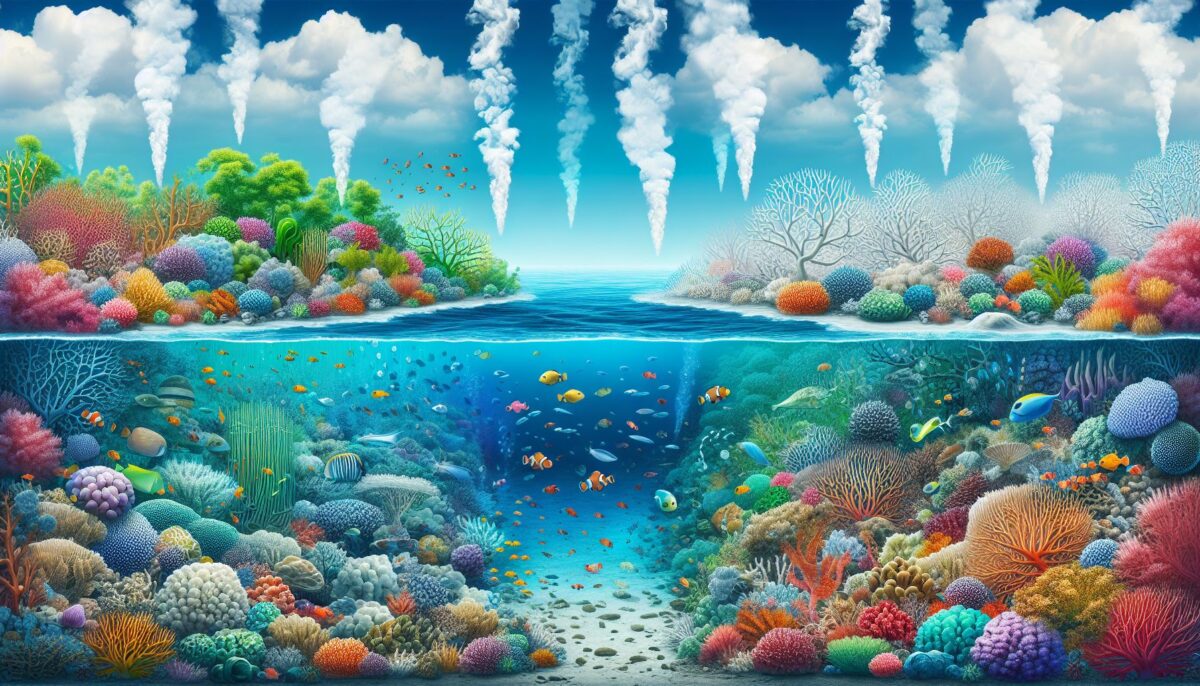
We often hear about the impact of carbon dioxide (CO2) on our atmosphere, global warming, and climate change. Yet, there is another, less discussed consequence of the increased levels of CO2: ocean acidification. It’s a phenomenon that poses a significant threat to marine life, entire ocean ecosystems, and the human communities depending on them.
Understanding Ocean Acidification
Ocean acidification refers to the process where the pH levels of the ocean become lower, which means it becomes more acidic. This occurs when the ocean absorbs CO2 from the atmosphere. When CO2 dissolves in seawater, it forms carbonic acid. This acid then releases hydrogen ions, which combine with carbonate ions to form bicarbonate, effectively reducing the ocean’s pH.
The Chemistry behind Ocean Acidification
The chemical reactions can be illustrated as follows:
CO2 (atmospheric) + H2O (water) ↔ H2CO3 (carbonic acid) ↔ H+ (hydrogen ion) + HCO3^- (bicarbonate ion)
Typically, carbonate ions are abundant in the ocean and are crucial in forming the shells and skeletons of many marine organisms, including corals, mollusks, and some species of plankton.
The Impact of Ocean Acidification on Marine Life
Coral Reefs
Coral reefs are often nicknamed the “rainforests of the sea” due to their richness in biodiversity. However, they are highly sensitive to changes in pH levels. Corals require carbonate ions to produce their skeletons. As ocean acidification progresses, the available carbonate ions decrease, and it becomes harder for corals to grow and repair their structures. This not only affects the corals themselves but also the plethora of species that rely on coral reefs for food and shelter.
Shellfish and Mollusks
Shellfish, such as mussels and clams, and mollusks like oysters, also see direct impacts from acidification. Their shells are composed mostly of calcium carbonate, and in more acidic waters, they struggle to maintain the integrity of their shells, leading to increased mortality rates.
Plankton
Plankton is at the base of the ocean food chain, and some species build shells from calcium carbonate. If these organisms are unable to survive in more acidic waters, it could cause a domino effect, impacting species up the food chain, including fish that serve as a primary protein source for billions of people.
Human Impact and Dependencies
Fisheries and Aquaculture
The seafood industry is highly vulnerable to the effects of ocean acidification. Shellfisheries are already experiencing the economic consequences as shellfish mortality rates increase. Aquaculture, relying on the cultivation of similar species, is also at risk.
Coastal Communities
Many coastal communities, particularly those in developing countries, rely heavily on the health of marine ecosystems for their livelihoods. They are directly affected by the reduced abundance of shellfish and altered fish stocks due to disrupted food chains.
The Broader Environmental Consequence
Ecosystem Imbalance
As a greater number of shell-forming organisms struggle to survive, there will be an imbalance in marine ecosystems. More aggressive algae growth can occur, leading to issues like harmful algal blooms (HABs) which can create toxins dangerous to marine and human life.
Biodiversity Loss
Ocean acidification threatens marine biodiversity. Unique species, some of which have yet to be studied or discovered, could be lost before we understand their roles in the ecosystem or their potential benefits to medical and scientific research.
Challenges in Addressing Ocean Acidification
Monitoring and Data Collection
Accurate monitoring and extensive data collection are essential to understand and address ocean acidification. Unfortunately, there is a lack of comprehensive data due to the vastness of the ocean and the complexity of its systems.
Awareness and Policy
Despite its significance, ocean acidification doesn’t receive as much attention as other environmental issues. This lack of awareness can lead to insufficient policy measures to mitigate the problem.
Mitigation and Adaptation Strategies
Reducing CO2 Emissions
The primary strategy to combat ocean acidification is to reduce CO2 emissions globally. This means transitioning to renewable energy sources and improving energy efficiency.
Protecting Marine Ecosystems
Establishing marine protected areas and minimizing other stressors like overfishing and pollution can help increase the resilience of marine life to acidification.
Research and Technology
Investment in research to understand the process of acidification and its impacts better, as well as in technologies such as selective breeding of resilient species, can be part of the solution.
Ocean Alkalinity Enhancement
There are geoengineering proposals like ocean alkalinity enhancement, which involves adding substances like olivine to seawater to increase carbonate ion concentration, thus counteracting ocean acidification.
Conclusion
Ocean acidification is a silent crisis that needs immediate attention. The actions we take now will determine the future health of our oceans and the survival of countless species, including our own.
Sources
-
NOAA PMEL Carbon Program: Understanding Ocean Acidification – https://www.pmel.noaa.gov/co2/story/What+is+Ocean+Acidification%3F
-
The Ocean Foundation: Ocean Acidification – https://oceanfdn.org/what-we-do/key-issues/ocean-acidification/
-
IPCC Special Report on the Ocean and Cryosphere in a Changing Climate: https://www.ipcc.ch/srocc/home/
Remember, this article should be used as a starting point for understanding the complex issue of ocean acidification. Readers who want more in-depth scientific research and data should refer to the provided sources and seek out additional peer-reviewed studies.
