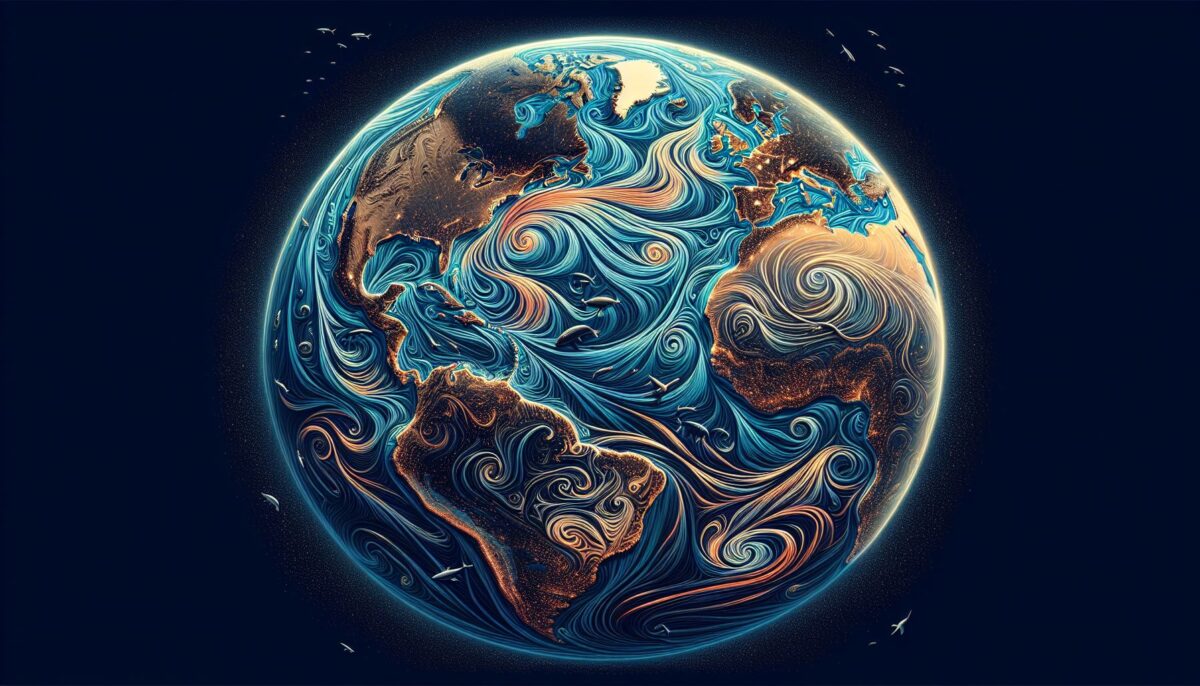
Ocean currents, those vast and powerful movements of ocean water, involve a complex, interplay of wind, the rotation of the Earth, and other factors. Cloak in mystery and full of surprising phenomena, they play an instrumental role in climate regulation, marine life movement, and even weather patterns. How do ocean currents work, and what impact do they have on the world we live in? Let’s dive in and explore.

Image Source: Pixabay
The Powerful Motor of Ocean Currents
The driving power for ocean currents primarily comes from the sun and the wind. Solar energy causes air to heat unevenly, which manifests as wind when warmer air moves towards cooler areas. This wind, in turn, creates ripples on the ocean’s surface that evolve into larger waves and eventually currents.
Another significant component at play here is the Earth’s rotation. The Coriolis effect, caused by the Earth’s spin, imparts a spiraling motion to the ocean currents depending on their latitude. This phenomenon results in a predominantly clockwise direction of currents in the northern hemisphere and anticlockwise currents in the southern hemisphere.

Image Source: Pixabay
Currents: The Surface and The Deep
Ocean currents are divided into two broad categories: surface currents and deep water currents. Surface currents constitute only 10% of the ocean water but cover 90% of the ocean’s area. They are primarily wind-driven and influenced by the Earth’s rotation. These currents are responsible for the bulk of oceanic heat transfer, playing a pivotal role in determining regional climates.
Deep water currents, or thermohaline currents, make up the remaining 90% of ocean water. They originate from differences in water density resulting from variations in temperature (thermo) and salt content (haline). Cold, salty water is denser and sinks to the bottom, while warmer, less salty water rises to the surface — a process known as convection. This forms a global conveyor belt-like system, connecting all of the world’s oceans and helping regulate the Earth’s climate.

Image Source: Pixabay
The Importance of Ocean Currents
Ocean currents are instrumental in nutrient cycling by transporting nutrients from the depths to the ocean surface where photosynthetic marine organisms thrive. This promotes biodiversity hotspots in regions like upwelling zones, where cold, nutrient-rich waters surge to the surface, attracting an abundance of marine life.
Currents also play a vital role in the global climate. For instance, the Gulf Stream, a powerful, warm Atlantic current, is responsible for the relatively mild climate of Western Europe. This current carries heat from the subtropics to the North Atlantic, mitigating the region’s winter chill.
On a worrying note, ocean currents have the ability to ferociously amplify the effects of climate change. Rapid melting of glaciers due to global warming can introduce freshwater into the ocean at a devastating rate, potentially disrupting the thermohaline circulation and subsequently changing climatic patterns.
Conclusion
Ocean currents, with their incredible power and intricate behavior, act as the cardiovascular System of our planet, circulating water, heat, and nutrients around the globe. They underscore the interconnectedness of Earth’s systems and remind us of the critical role the ocean plays in maintaining the delicate balance of our global climate.
Undeniably, there is still much to learn. As we continue to unravel the mysteries of these marine juggernauts, our understanding of Earth and the pressing issue of climate change will inevitably grow. It underscores the urgent need for extensive research while fostering a sense of respect and responsibility towards this life-sustaining planetary feature.
Discover more about ocean currents