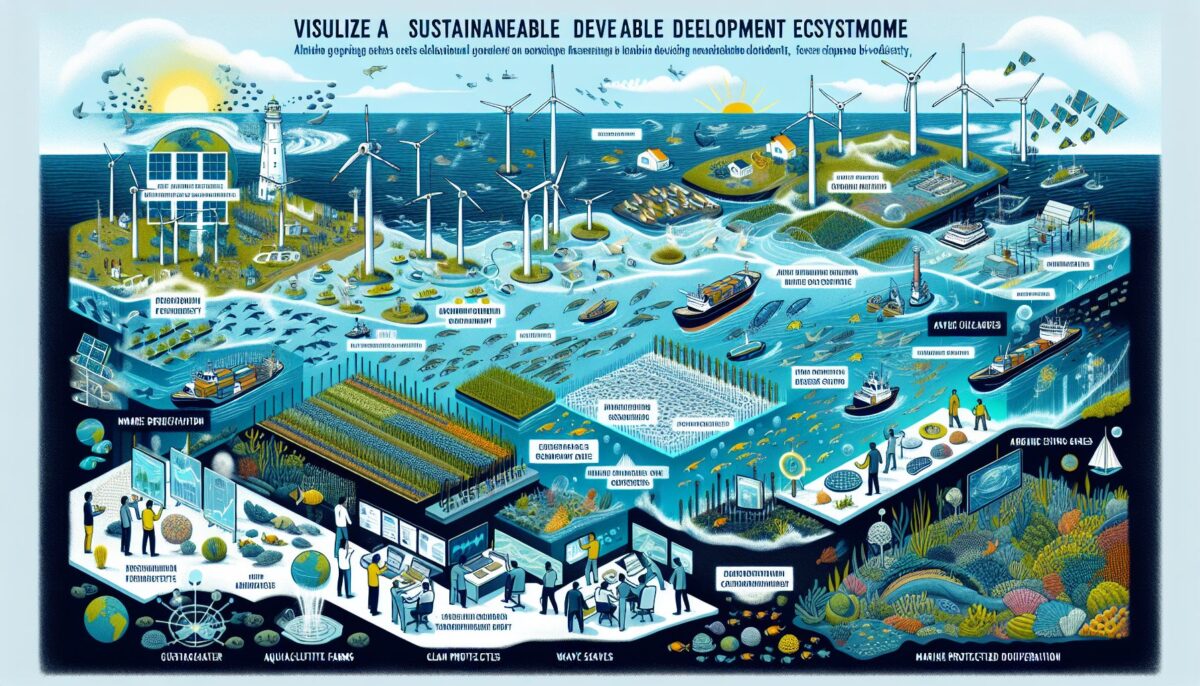
When we talk about economy, most people think of exchange of goods and services on land. However, a significant part of global economic activity is driven by the oceans which make up for more than two-thirds of Earth’s surface. This vast and largely untapped economic potential of oceans is referred to as the Blue Economy. It is a growth sector which generates billions of dollars and sustains millions of jobs worldwide. This article aims to develop a better understanding of the Blue Economy and its role in promoting economic growth, social inclusion, and preservation of the marine environment.
The World Bank defines the Blue Economy as the “sustainable use of ocean resources for economic growth, improved livelihoods, and jobs while preserving the health of the ecosystem.” Today, more than three billion people depend on marine and coastal biodiversity for their livelihoods. Additionally, the estimated market value of marine and coastal resources and industries is $3 trillion per year, or about 5% of global GDP.
The Blue Economy covers a wide range of sectors, including fisheries, aquaculture, tourism, shipping and ports, maritime trade, energy, and maritime security, among others. It goes beyond simply generating economic growth to encompassing improved human well-being and equity, and environmental sustainability. In this sense, the Blue Economy is a crucial pillar of the United Nations Sustainable Development Goals.
Fisheries and Aquaculture
Fisheries and aquaculture represent one of the most important sectors of the Blue Economy. As per FAO’s 2020 SOFIA report, global fish production peaked at about 179 million tonnes in 2018, providing the world with 20.5 kilograms of fish per capita, and offering direct employment to about 59.5 million people. We can’t overlook that illegal and unregulated fishing has a negative impact on our oceans, thus seeking sustainable methods remains a priority for the sector.
Maritime Trade and Shipping
Maritime trade and shipping are other key sectors of the Blue Economy. Approximately 80% of global trade by volume and over 70% by value is carried by sea and handled by ports worldwide. As per United Nations Convention of Trade and Development (UNCTAD’s Review of Maritime Transport 2018), sea trade continues to expand, with volumes climbing to 10.7 billion tons in 2017.
Marine Energy
Marine energy is another promising area within the Blue Economy. The potential for harnessing the power of the ocean – through waves, tides, salinity gradients, and temperature differences – is immense. The International Energy Agency (IEA) estimates that the technically achievable energy potential for marine technologies could correspond to more than double the global electricity demand in 2040. These technologies are greener energy alternatives that help mitigate climate change by reducing fossil fuel dependence.
However, for all its economic potential, the Blue Economy is facing significant challenges. Rising sea temperatures, ocean acidification, coral bleaching, marine pollution, and overfishing are some of the major issues threatening the sustainable growth of the Blue Economy. Therefore, it needs to be coupled with strong stewardship of the marine environment.
To conclude, the Blue Economy is not just about economic growth; it is about balancing economic growth with social inclusion and environmental sustainability. It is about recognizing and properly valifying the full array of economic, social and environmental benefits that the oceans can provide. With the development of the marine environment comes the responsibility to protect it, to ensure the long-term sustainability of our planet.
