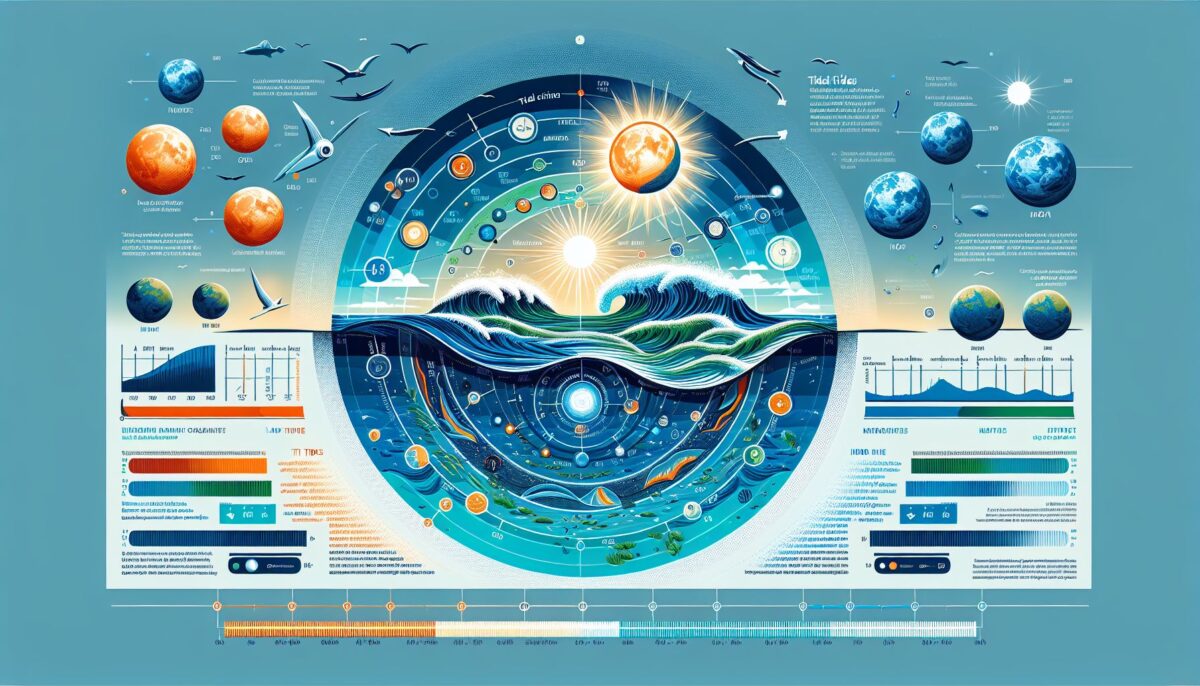
The ocean is a marvel of nature, its vast expanse covering over 70% of the Earth’s surface and influencing weather, climate, and supporting a diverse array of life. Among the ocean’s many features, tides stand as a critical yet often misunderstood phenomenon. Tides are far more than the simple rise and fall of sea levels—they are a complex system driven by celestial mechanics that affect ocean currents, marine life, and human activities. In this comprehensive exploration, we delve into the fascinating world of tides, their characteristics, and their impact on planet Earth.
What Are Tides?
Tides are the long-period waves that rise and fall of sea levels caused by the gravitational forces exerted by the moon and the sun and the rotation of the Earth. While the concept seems straightforward, the mechanism behind tides is quite complex.
The Gravitational Pull
The primary forces behind tides are the gravitational attraction between the Earth and the moon, and to a lesser extent, the sun. The side of the Earth closest to the moon experiences a stronger pull, causing the water to bulge outwards, creating what is known as the “high tide.” The centrifugal force, due to the Earth-moon system’s rotation, causes another bulge on the opposite side of the Earth, resulting in a second high tide. The areas between these bulges experience “low tides.”
The Role of the Sun
The sun also plays a significant role in tidal movements. When the Earth, moon, and sun align during new and full moons, the solar tide combines with the lunar tide to create “spring tides,” which are higher and lower than normal. Conversely, when the sun and moon are at right angles to each other, during the first and third quarters of the moon, “neap tides” occur, which are relatively mild.
Types of Tides
Tides vary in their frequency and magnitude depending on geographical location and the relative positions of the Earth, moon, and sun.
Diurnal, Semidiurnal, and Mixed Tides
There are three primary tidal patterns:
– Diurnal Tides: One high and one low tide each lunar day.
– Semidiurnal Tides: Two high and two low tides of approximately equal size every lunar day.
– Mixed Tides: A combination of two high and low tides of different sizes.
The type of tide experienced at a given location is influenced by the shape of the coastline, the ocean floor, and the depth of the ocean, among other factors.
Measuring Tides: The Science of Tide Prediction
Tide prediction is a complex science that involves understanding the movements of the celestial bodies and local factors. Tidal patterns are predictable due to the regular movements of the moon around the Earth and the Earth around the sun.
Tidal Stations and Data Collection
Tidal stations equipped with tide gauges measure the sea level over time. This data, combined with meteorological information and historical records, helps scientists develop tide tables and predict future tidal patterns.
The Role of Computations
Sophisticated computer models analyze the collected data and consider the astronomical influences, sea-floor topography, and the dynamics of ocean currents, resulting in highly accurate tidal predictions.
The Impact of Tides on the Environment and Human Life
Tides influence a wide range of environmental and human activities, demonstrating their importance beyond just the rise and fall of sea levels.
Coastal Ecosystems
Tides create intertidal zones, which are rich in biodiversity. These areas are home to numerous species adapted to the changing environment, including crustaceans, mollusks, and various types of algae.
Marine Navigation
For centuries, tides have played a critical part in marine navigation. Knowledge of tidal patterns is essential for the safe passage of ships, especially when navigating through channels, straits, or entering and leaving ports.
Fisheries and Aquaculture
Tides affect the availability of nutrients in the water, which impacts fish behavior and marine farming. Fisheries and aquaculture operations rely on understanding tidal patterns for optimal harvesting and cultivation.
Tidal Energy
Tides are also a source of renewable energy. Tidal energy systems, such as tidal barrages and underwater turbines, harness the kinetic energy of tidal currents to generate electricity.
Challenges: Tides and Climate Change
Climate change is affecting tides and the overall health of marine ecosystems. Rising sea levels due to melting ice caps and glaciers are altering tidal patterns, potentially leading to increased coastal erosion and flooding.
Adapting to Changing Tides
Coastal communities and industries must adapt to these changing conditions. Improved coastal management strategies, such as building sea walls or retreating from vulnerable areas, are essential to mitigate the impact of climate change on tidal patterns.
Conclusion
Tides are a powerful force shaping our coastal landscapes, ecosystems, and the way we interact with the ocean. As we continue to explore the depths of oceanography and marine science, understanding and respecting the tidal forces at play will remain crucial for sustainable development and the conservation of our planet’s blue heart.
Sources
- NOAA’s Tides and Currents. Available at: https://tidesandcurrents.noaa.gov/
- Tide Predictions and Data. Available at: https://www.ukho.gov.uk/productsandservices/papercharts/pages/tide-tables.aspx
- Tidal Energy. Renewable Energy World. Available at: https://www.renewableenergyworld.com/baseload/tidal-energy-technology/
Please note that while empirical information does not typically expire, more recent data or discoveries post the knowledge cutoff date may not be included in this article.
