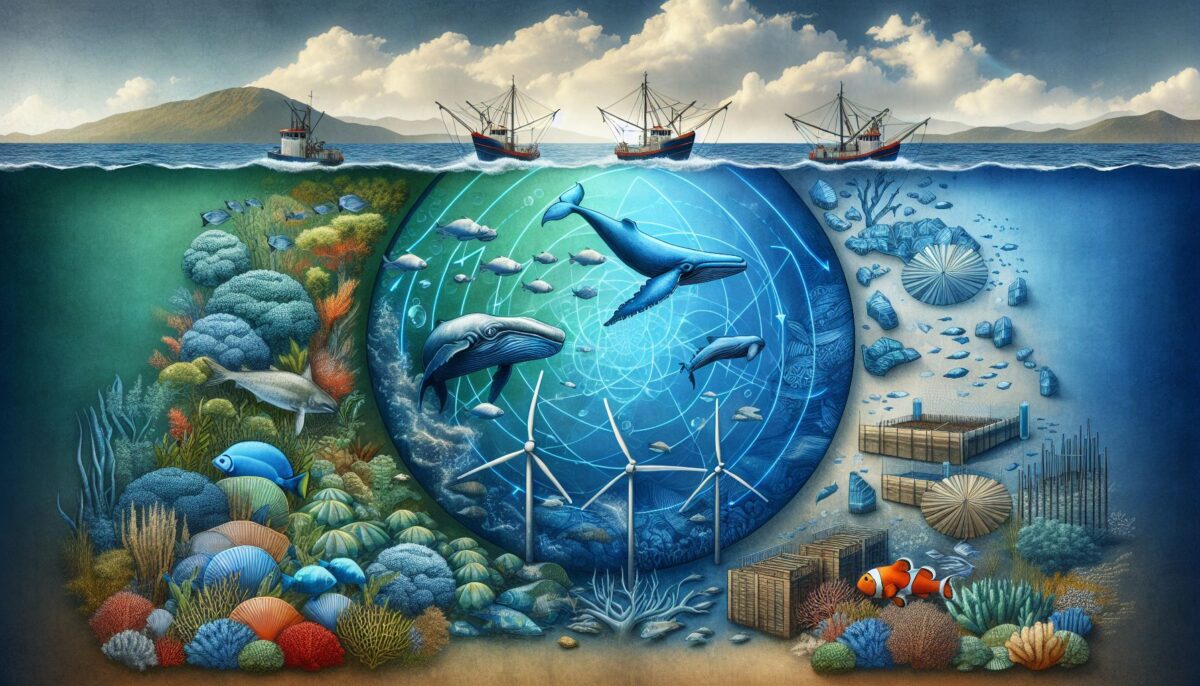
The global ocean, encompassing everything from the deep sea to the coastal zones, forming bays, and spread across vast archipelagos, constitutes one of Earth’s most vital and extensive ecosystems. It’s a field so intricate and expansive that it not only includes marine life, hydrography, and maritime trade but also encompasses emerging disciplines such as oceanography and marine geology. However, amid the complex interplay of ecological processes and human activity, there’s an essential concept that has gained traction: the Blue Economy.
What is the Blue Economy?
The Blue Economy refers to the sustainable use of ocean resources for economic growth, improved livelihoods, and jobs while preserving the health of ocean ecosystem. It encompasses a broad range of sectors, including fisheries, aquaculture, maritime trade, tourism, and energy. Moreover, the concept of the Blue Economy goes beyond economic activity, calling for a careful balance between marine resource exploitation and conservation, ensuring that the prosperity derived from the oceans does not compromise their ecological integrity.
Fisheries and Aquaculture: Key Pillars of the Blue Economy
Fisheries and aquaculture are two vital components of the Blue Economy. According to the FAO, over 57 million people were engaged in the primary sector of capture fisheries and aquaculture in 2016. These industries not only provide a significant source of protein to billions but also offer employment opportunities and economic security to coastal communities around the globe.
Sustainable Fisheries
Fisheries must be managed sustainably to ensure that fish stocks remain at healthy levels to support ecological balance and food security. Overfishing and illegal fishing practices threaten many species and can have cascading effects on marine ecosystems.
Marine Protected Areas
One cogent strategy for promoting the sustainability of fisheries is the establishment of Marine Protected Areas (MPAs). MPAs are designated zones where human activity is restricted to varying degrees to conserve the marine environment and biodiversity. According to the World Bank, effectively managed MPAs can yield fish biomass increases of 446% on average within the protected zone.
Aquaculture Development
Aquaculture, or the breeding, rearing, and harvesting of aquatic organisms, provides a complementary path to meeting the world’s seafood demand while alleviating pressure on wild fish populations. Innovations such as integrated multi-trophic aquaculture (IMTA), which mimics natural ecosystems, show promise in enhancing sustainability.
Marine Renewable Energy: Harnessing Wind, Wave, and Tidal Power
As we transition towards renewable sources, the ocean plays an ever-increasing role in energy generation:
-
Wind: Offshore wind farms, due to the strong and consistent winds at sea, offer a higher output compared to their onshore counterparts.
-
Wave and Tidal Energy: The kinetic energy of waves and the gravitational pull of tidal forces present immense, largely untapped reservoirs of energy. Technologies designed to harness this energy are being developed, such as tidal turbines and wave energy converters.
Tourism: Capitalizing on Coastal and Marine Beauty
Coastal and marine tourism merges economic development with the appreciation of nature. With activities ranging from beach visits to diving in coral reefs, this sector connects people to the ocean, fostering a public interest in marine conservation.
The Environmental Pillars of the Blue Economy
Coastal Management and Erosion Control
Effective coastal management policies are crucial for safeguarding habitats against the effects of climate change, such as sea-level rise and storm surges. Techniques incorporate both hard engineering structures and soft solutions such as mangrove replanting.
Marine Pollution and Ocean Cleanup
One of the biggest environmental challenges faced by our oceans is pollution. Initiatives to combat marine pollution include reducing inputs from land, such as nonpoint source pollution, managing marine debris, and responding to oil spills.
Ocean Cleanup Efforts
Organizations such as The Ocean Cleanup are developing technologies to remove plastic from the oceans, aiming to mitigate the impacts of marine debris on ecosystems and marine life.
Combating Ocean Acidification and Coral Bleaching
The increasing levels of CO2 are not only a climate concern; they also lead to ocean acidification which has adverse effects on marine life, particularly calcifying organisms like corals. Efforts to protect reefs include promoting resilience through MPA designation and restorative aquaculture techniques.
The Blue Economy in Data: Oceanographic and Marine Geological Research
The roles of oceanography and marine geology in the Blue Economy cannot be understated. They not only provide critical information on marine resources but also offer insights into climate change, seafloor mapping, and understanding the processes governing ocean currents and tides.
Oceanographic Data and Navigational Technology
Advancements in oceanographic data collection and navigational technology have revolutionized shipping by improving maritime trade routes’ safety and efficiency. This includes the use of advanced sonar for bathymetry and the development of precise GPS systems.
Looking Forward: Challenges and Opportunities
Offshore Drilling and Renewable Transitions
While offshore drilling contributes significantly to the energy sector, the move towards renewable energy, such as offshore wind, presents an opportunity to phase out fossil fuel extraction in favor of more sustainable energy sources.
Desalination and Water Scarcity
As freshwater becomes increasingly scarce, desalination offers a solution by converting salt water to drinking water. However, the technology must be developed sustainably to avoid adverse environmental impacts.
Maritime Trade Adaptations
Maritime trade must adapt to the realities of climate change. Ports and harbors face the dual challenge of ensuring resilience in the face of sea-level rise while reducing their carbon footprint to mitigate further climate change impacts.
Marine Biotechnology and Genetic Resources
The exploration of marine genetic resources opens up new avenues for pharmaceuticals, biofuels, and material science. Ensuring that benefits derived from these resources are shared equitably is an integral part of a sustainable Blue Economy.
Conclusion
The Blue Economy represents a paradigm shift toward a more sustainable oceanic future, embracing economic practices that honor and protect our seas’ rich biodiversity and ecosystems. Its principles encourage us to balance human needs with the health of marine environments, ultimately contributing to global goals of poverty alleviation, food security, and climate resilience.
For further reading, consider these resources:
- The World Bank – What is the Blue Economy?
- Food and Agriculture Organization of the United Nations – The State of World Fisheries and Aquaculture 2020
- The Ocean Cleanup
By embracing the Blue Economy, we can ensure that the world’s oceans continue to flourish, providing vital resources for today’s needs and preserving its wondrous splendor for future generations.
