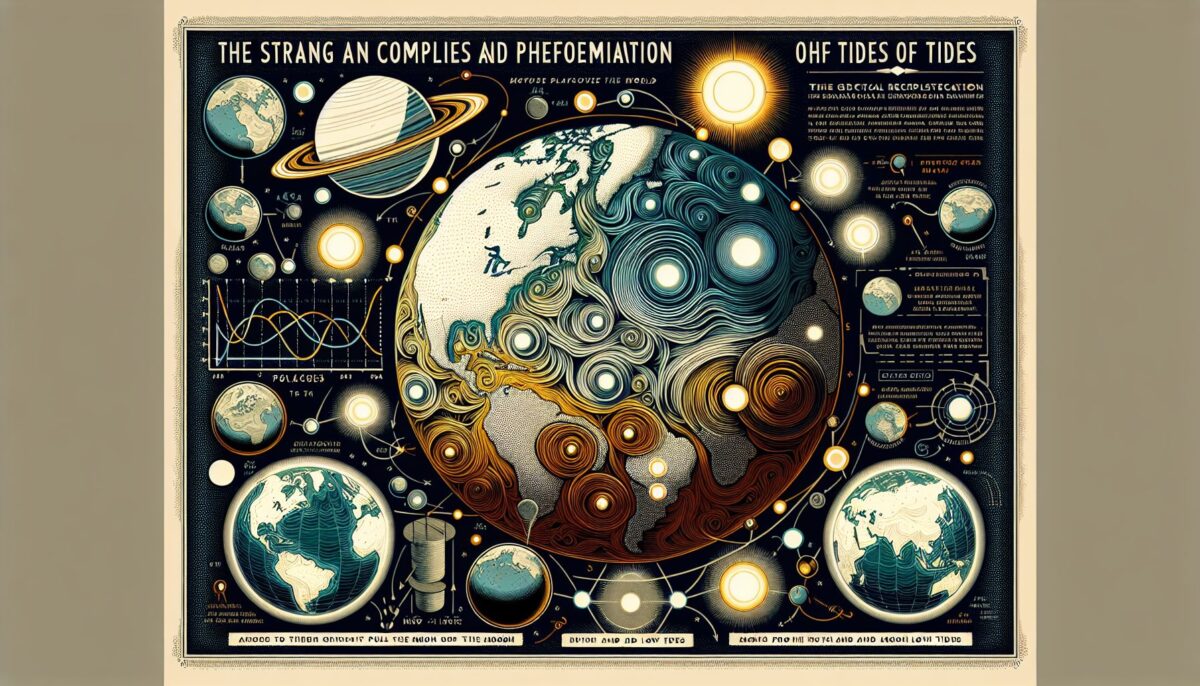
Tides are among the most fascinating and seemingly magical phenomena in our world. They are the pulsating heartbeat of our planet, affecting everything from the rhythm of marine life to the frequency of fishing trips, to the safety and effectiveness of shipping routes. In the greater context of the ocean ecosystem, they contribute to the health of marine biodiversity, act as a significant driving force behind ocean currents, coastal erosion, and tsunami generation. As we delve deeper into the understanding of tides, we will explore not only the intriguing science behind their occurrence but also their far-reaching impacts on our planet.
What are tides?
In simple terms, tides are the regular rise and fall of the ocean’s surface caused by the gravitational pull of the moon and the sun. This gravitational force, combined with the Earth’s rotation, creates a complex dance of tidal bulges – areas of high and low tide. The position and alignment of the Moon and the Sun relative to the Earth impact the strength and timing of the tides. Tides can differ from place to place and can greatly fluctuate daily, on what is known fascinatingly as a ‘Tidal Day.’
The Science Behind Tides
The gravity of the moon is the primary driver of our tides[^1^]. As the moon orbits the Earth, its gravity pulls on the planet’s waters, causing changes in sea level. When the moon is on one side of the Earth, it causes a tidal bulge on that side, which is experienced as high tide. Similarly, on the opposite side of the Earth, due to the planet’s rotation away from the moon, another high tide occurs. Low tides, conversely, happen at the areas between these bulges.
The Sun, while much larger than the Moon, has less influence over our tides because of its greater distance from Earth. However, it does have a noticeable effect. When the sun and moon are aligned with the Earth at the new moon and full moon phases, their combined gravity makes the high tides higher and the low tides lower. This phenomena is known as spring tides. During the first and third quarter moons when the sun and moon are at right angles to each other, their gravitational forces somewhat cancel each other out, resulting in neap tides – these are tides with the least difference between high and low water.
The Influence of Tides on Marine Life
Tidal variations have evolved to play an essential role in dictating the behavior of marine life[^2^]. For instance, many species of fish, invertebrates, and even marine mammals such as seals and dolphins, have adapted to follow tides to feed, breed, and avoid predators. The intertidal zones, areas between the high tide and low tide marks, become particularly important as these zones nurture diverse species whose life cycles are intricately tied to the tide cycles.
Tides and Human Activity
Tides significantly influence human activities, especially those connected to the sea. For centuries, fishermen have relied on understanding tides to optimize their catch. In coastal regions, high tides signal optimal conditions for fishing, while low tides reveal extensive areas for collecting shellfish.
The shipping industry has particularly felt the impact of tides, with arrival and departure times often scheduled around high tides to ensure the ships have enough water depth to navigate safely in harbors or bays.
Beyond that, tides are being leveraged as a powerful source of clean, renewable energy. Tidal energy systems capture the kinetic energy of moving water and convert it to electricity, a technology that could be a key player in reducing dependence on fossil fuels and combating climate change[^3^].
Conclusion
Understanding the movements of tides blind us the opportunity to introspect into the profound influence these oscillations hold in shaping coastlines, directing marine life, steering human maritime activities, and defining the health & fabric of the oceans. As our planet continues to change due to human activity, understanding, and preserving these natural rhythms of the Earth is more critical than ever.
[^1^]: National Oceanic and Atmospheric Administration. “Tides and Water Levels” https://oceanservice.noaa.gov/education/tutorial_tides/
[^2^]: MarineBio Conservation Society. “Marine Life / Marine Vertebrates”. https://marinebio.org/oceans/marine-life/
[^3^]: Union of Concerned Scientists. “How Tidal Energy Works”. https://www.ucsusa.org/resources/how-tidal-energy-works
