Tides, those regular and predictable movements of seawater, have captivated humanity since time immemorial. They are not just an intriguing natural phenomenon but also a critical factor in coastal life, maritime navigation, and the earth’s biological rhythms. Understanding tides is a window into the vast influences that shape our planet and the life upon it. Here, we delve into the complexities and simplicities of tides, their mechanics, human interactions, and how they impact life on Earth.
The Science of Tides
To decipher the dance of the tides, one must first understand the players and their movements. The Earth, Moon, and Sun engage in a complex gravitational choreography that determines the rise and fall of sea levels.
Gravitational Pull and Tidal Forces
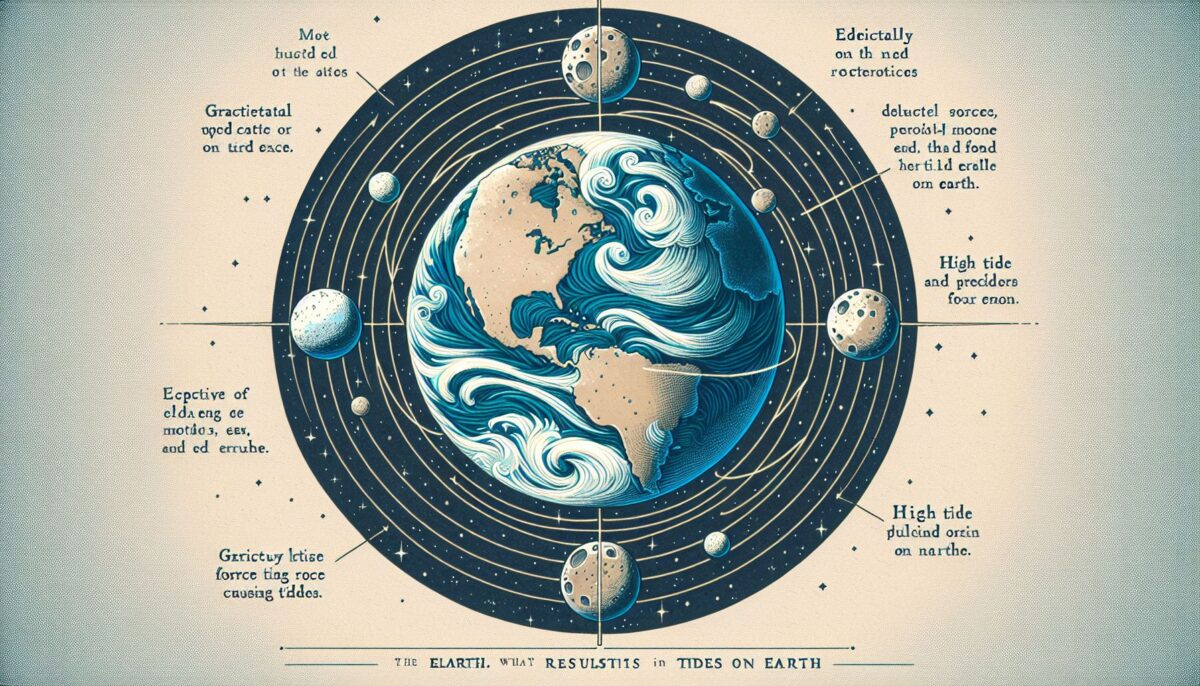
At the heart of tidal movements are the gravitational forces exerted by the Moon and, to a lesser extent, the Sun. As the Moon orbits the Earth, it pulls the water on the side closest to it slightly toward itself, creating a bulge — this is known as the direct tidal force.
markdown

**Direct Tidal Force:** The gravitational pull of the Moon (or Sun) that causes the oceans to bulge out in the direction of the Moon (or Sun).
Concurrently, on the opposite side of the Earth, inertia — the tendency of the water to resist change — creates a second bulge. Since the Earth is also pulled toward the Moon more than the water on the far side, this results in another high tide creating a phenomenon referred to as the indirect tidal force.
High Tides and Low Tides
The bulges associated with these forces are high tides, while the areas perpendicular to the bulges experience low tides. Any given coastal location on Earth thus typically experiences two high tides and two low tides over a 24-hour period — a semidiurnal tide cycle. However, some locations may have only one of each, known as diurnal tides, due to complex interactions within ocean basins.
markdown

**Semidiurnal Tide Cycle:** Characterized by two high tides and two low tides each day.

**Diurnal Tide Cycle:** Characterized by a single high tide and a single low tide each day.
Spring Tides and Neap Tides
The Sun’s gravitational pull is also at play, though it’s less powerful than the Moon’s due to the larger distance. When the Earth, Moon, and Sun align — during the new moon and full moon — the solar and lunar tides reinforce each other, leading to spring tides, which have higher high tides and lower low tides.
In contrast, during the first and third quarters of the moon, when the gravitational forces of the Moon and the Sun are perpendicular to each other, the result is neap tides, with less extreme differences between high and low tides.
The Impact of Tides on Life and Human Activity
Tides have profound influences on marine ecosystems, human livelihoods, coastal development, and even renewable energy resources.
Marine Life
Intertidal zones — areas between high and low tide marks — are rich in biodiversity and are home to specialized life forms that can withstand vast environmental changes. Organisms in these areas have adapted to survive periods of submersion in saltwater and exposure to the air and sun.
Maritime Navigation
Tides dictate the accessibility of many ports and harbors. Mariners must plan their routes and harbor approaches based on tidal forecasts to avoid running aground in low-tide conditions.
Renewable Energy: Tidal Power
The kinetic energy of moving water in tidal currents can be harnessed through various technologies to generate electricity, offering a sustainable energy source. Tidal energy is predictable and consistent, setting it apart from other renewables like wind and solar power.
Tidal Phenomena and Events
Some extraordinary tidal events and phenomena captivate both scientists and the public alike.
King Tides
“King tides” are exceptionally high tides that occur when there is alignment of the Earth, Moon, and Sun, and when the Moon is closest to Earth (perigee) during its elliptical orbit. These tides can cause coastal flooding, especially when combined with adverse weather conditions.
Tidal Bores
A tidal bore is a strong tide that pushes up a river or narrow bay against the direction of the river’s current. Famous examples include the Qiantang River in China and the Severn River in the United Kingdom.
The Challenges Ahead: Tides and Climate Change
As climate change leads to rising sea levels, tidal impacts on coastal communities will intensify. Potential challenges include:
Coastal Erosion
Higher sea levels mean that high tides have more energy and can cause greater erosion, threatening infrastructure and ecosystems.
Flooding and Habitat Loss
Increased tidal ranges and storm surges can lead to more frequent and severe coastal flooding, resulting in habitat loss for wildlife and displacement of human communities.
Human Responses to the Tidal Challenge
Humanity has responded to the challenges of tides with both respect and innovation, developing coastal management strategies and exploring the potential of tidal energy.
Coastal Management
Sustainable coastal management efforts involve creating infrastructure that works with natural tidal processes, such as living shorelines that use natural materials to reduce erosion.
Tidal Energy Advancements
Advancements in tidal energy technology promise a future where the predictable power of tides contributes more significantly to the global energy mix, reducing reliance on fossil fuels.
Sources
- National Oceanic and Atmospheric Administration (NOAA) – Tides and Water Levels: https://www.noaa.gov/
- International Renewable Energy Agency (IRENA) – Tidal Energy Technology Brief: https://www.irena.org/
- Intergovernmental Panel on Climate Change (IPCC) – Sea Level Change: https://www.ipcc.ch/
Conclusion
Tides remain one of nature’s most fascinating phenomena. Their predictable patterns and extreme events continue to impact our world in myriad ways. As we move forward, understanding tides will become increasingly critical in managing coastal ecosystems, developing maritime industries, and adapting to our changing environment. The rhythm of tides is not just a dance of oceanic waters but a pulse that affects the very lifeblood of planet Earth.
