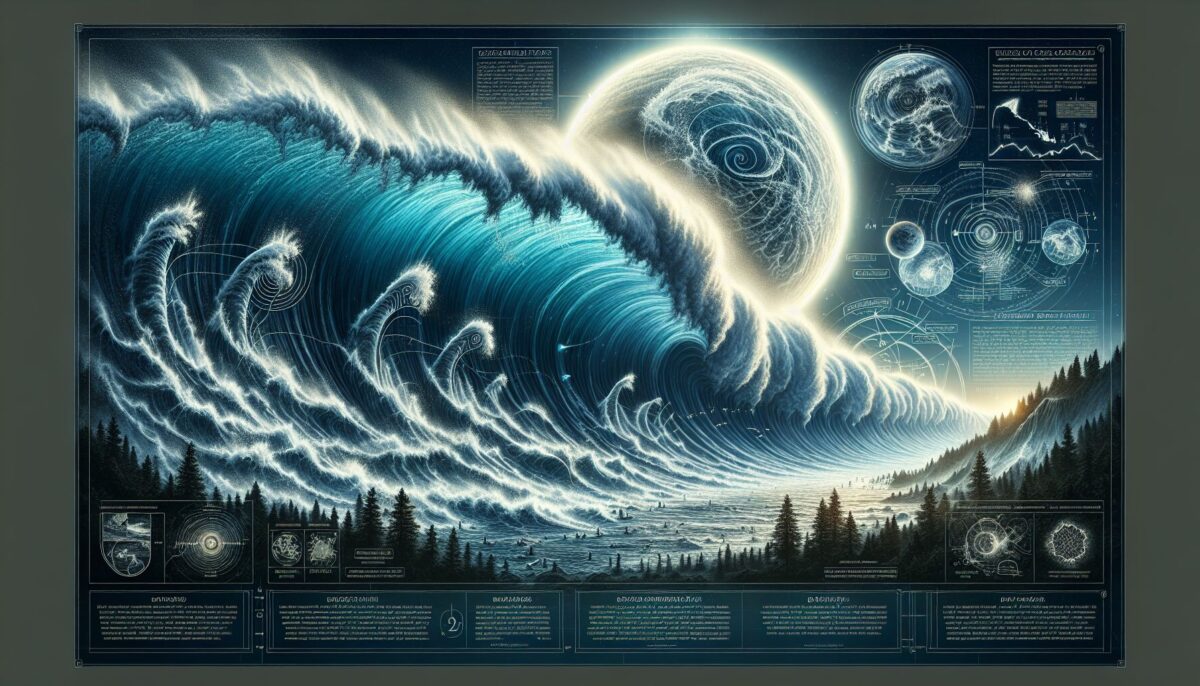
Tsunamis, derived from the Japanese words ‘tsu’ meaning harbor and ‘nami’ meaning wave, are a series of ocean waves with immense power and energy, triggered primarily by underwater disturbances. These giant waves, once propelled towards the coast, have the capacity to destroy anything in their path. In this comprehensive article, we will delve deep into the nature of tsunamis, their causes, historical impacts, and the modern measures in place to mitigate their destructive potential.
Understanding Tsunamis
Tsunamis are often mistakenly called tidal waves, but their origins and characteristics are unrelated to the tides, which are caused by the gravitational pull of the moon and the sun. Tsunamis can be described as a series of enormous waves usually caused by disturbances such as volcanic eruptions, underwater earthquakes, and, less frequently, landslides or meteorite impacts.
Causes of Tsunamis
The most common cause of tsunamis is undersea earthquakes at tectonic plate boundaries. When the ocean floor at these boundaries rises or falls abruptly, it displaces the water above it and launches the rolling waves that will become a tsunami.
Other causes include:
- Volcanic eruptions: When a volcano violently erupts, it can displace enough water to generate a tsunami. The infamous Krakatoa eruption of 1883 is a prime example.
- Landslides: Either above ground or underwater, landslides can precipitate large displacement of water, initiating a tsunami.
- Meteorite impacts: Though rare, large meteorites hitting the ocean can release enormous energy to form a tsunami.
How Tsunamis Form and Travel
The process of a tsunami’s formation and its subsequent journey across the ocean can be broken down into several stages:
- Initiation: A sudden displacement of a large volume of water.
- Split: The initial tsunami then splits into two, with one part heading out to the deep ocean, and the other toward the nearest coast.
- Amplification: As it travels into shallower coastal waters, the wave’s speed decreases, and its amplitude increases significantly.
- Inundation: The wave can travel inland, flooding vast areas with salty seawater.
Tsunamis can traverse whole ocean basins; the tsunami that struck Thailand in 2004 originated from an earthquake off the coast of Sumatra, Indonesia, over 1,000 miles away.
Historical Impacts of Tsunamis
Tsunamis have reshaped coastlines and civilizations throughout history. Here are a few significant events:
- 2004 Indian Ocean Tsunami: Triggered by a massive earthquake with a magnitude of 9.1–9.3, it was one of the deadliest natural disasters in recorded history, resulting in over 230,000 deaths across 14 countries.
- 2011 Tōhoku Earthquake and Tsunami: A magnitude 9.0 earthquake off the coast of Japan caused a tsunami that led to the Fukushima Daiichi nuclear disaster, one of the most severe nuclear accidents since Chernobyl.
Modern Tsunami Warning Systems and Mitigation Measures
Recognizing the dire need to forecast and mitigate the impact of tsunamis, nations worldwide have established warning systems:
- Deep-Ocean Assessment and Reporting of Tsunamis (DART): A system of buoys that provide data on tsunamis in progress, allowing for timely warnings.
- Tsunami Warning Centers (TWCs): Facilities that monitor Earthquakes and assess their potential to generate tsunamis.
- Public Education and Evacuation Plans: Coastal communities have developed evacuation plans, and ongoing public education efforts are crucial in saving lives during a tsunami event.
The Role of Technology in Tsunami Detection
Technology plays an indispensable part in detecting tsunamis and disseminating warnings. Seismographs detect earthquakes, and tidal gauges measure sea level changes. However, the most crucial data come from a network of DART buoys. These buoys can detect minute changes in water pressure indicating a tsunami’s passage and relay the information to the warning centers.
Tsunami-Resistant Infrastructure
Efforts in architectural design and urban planning are essential for creating tsunami-resistant infrastructure. This includes building walls to deflect waves, elevating homes, and constructing vertical evacuation shelters. Japan, known for its frequent encounters with tsunamis, has some of the most advanced structures designed to withstand these catastrophic events.
The Future of Tsunami Research
The science of tsunamis is always advancing. Researchers are constantly refining models for better prediction and understanding of how tsunamis interact with coastlines.
The Impact of Climate Change on Tsunamis
While tsunamis are primarily geological in origin, climate change may indirectly increase the risk by causing sea levels to rise and making coastal communities more vulnerable to tsunami inundation. Additionally, the increased incidence of extreme weather events could trigger more landslides—both subaqueous and terrestrial—that may lead to tsunamis.
Tsunamis and Global Preparedness
Global initiatives, such as the United Nations’ “Sendai Framework for Disaster Risk Reduction,” promote international cooperation in disaster risk reduction, recognizing the need to enhance global preparedness for events like tsunamis.
Sources for Further Reading
- National Oceanic and Atmospheric Administration (NOAA)
- The United Nations Office for Disaster Risk Reduction: Sendai Framework
- International Tsunami Information Center (ITIC)
Conclusion
Tsunamis, though infrequent, present a potent threat to coastal communities across the globe. The development of sophisticated detection technologies and a deeper understanding of Earth’s geological processes have bolstered our capacities to prepare for and respond to these natural phenomena. Continuing to improve tsunami education, warning systems, and global coordination remains imperative to minimizing the impact on human lives and livelihoods. As we increase our respect for nature’s force through continuous research and preparedness, we also build resilience against the waves of change and disruption brought on by tsunamis.
