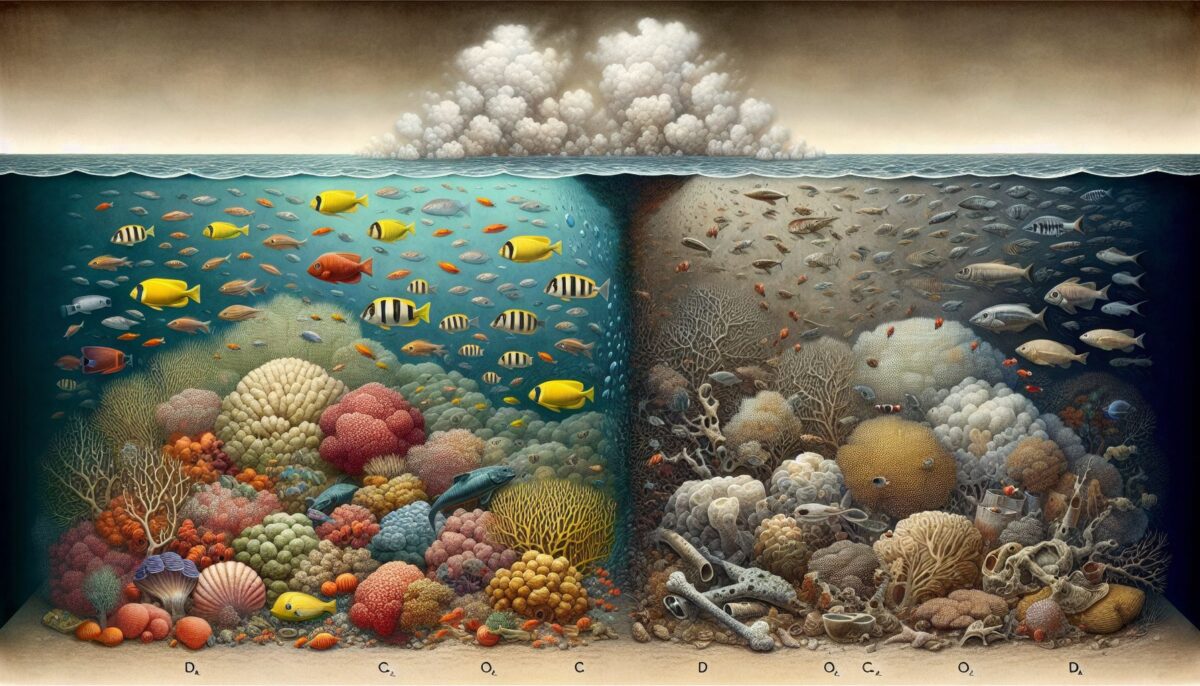
“Man cannot discover new oceans unless he has the courage to lose sight of the shore.” These words from André Gide capture the inspiring, mysterious draw of the seas. Yet, our often negligent actions on land pose a severe and underacknowledged threat to ocean health: ocean acidification. A silent villain, it’s gradually eroding the crucial biodiversity of oceans, the precious treasure hidden beneath the vast waters.
Introduction to Ocean Acidification
Ocean acidification, at its most basic, is the continuous decrease in seawater pH caused by the absorption of human-released carbon dioxide (CO2) from the atmosphere[^1^]. When CO2 reacts with seawater, it produces carbonic acid, a substance that increases the acidity of the ocean, causing pH to decrease.
This process becomes a threat when it occurs more rapidly than marine organisms and ecosystems can accommodate, posing severe consequences for marine life, particularly species with calcium carbonate shells and skeletons.
The Underlying Mechanism
The seas absorb about a quarter of human-generated CO2 emissions, acting as a buffer to climate change on land. On the one hand, this curbs global warming effects and keeps our planet liveable. However, on the other hand, there’s a cost: when CO2 dissolves in seawater, it forms carbonic acid. This acid dissociates in water, releasing bicarbonate ions and hydrogen ions, which cause the seawater to become more acidic. This alters seawater’s chemistry, often destabilizing the marine ecosystems’ delicate balance.
Impacts on Marine Biodiversity
The primary victims of ocean acidification are the shelled organisms: from tiny planktonic species to larger shellfish and the calcified algae that nourish them. The increased acidity in the ocean results in fewer carbonate ions, a vital component used by these creatures to build their shells or skeletal frameworks.
Shelled organisms sit in different trophic levels, often at the bottom. Any disturbance at the base reverberates up the food chain, impacting predators and reducing overall biodiversity. Furthermore, many shelled organisms play vital roles in providing habitat and ecological function for others, influencing the broader benthic (seafloor) landscape and ecosystem.
Corals, comprising large calcium carbonate structures, are particularly vulnerable. Degradation of coral reefs — vibrant, teeming hotspots of marine biodiversity — has far-reaching impacts both ecologically and economically, disrupting tourism, fishing, and other facets of the blue economy.
Research from the University of California, Davis, suggests that ocean acidification could decimate fisheries, with the effects already being seen. In the Pacific Northwest, oyster larvae have struggled to build their shells, leading to a massive plummet in oyster populations[^2^].
Combatting Ocean Acidification
The fight against ocean acidification involves global, collective efforts to reduce CO2 emissions significantly. Utilizing carbon capture & storage techniques to remove CO2 from the atmosphere can help lower the rate of acidification.
Moreover, protecting marine habitats that absorb CO2, such as mangroves, seagrasses, and salt marshes, is vital. These ecosystems not only provide habitat and nursery grounds for many marine organisms, but they also sequester large amounts of carbon.
Marine protected areas (MPAs), where human activity is limited, can also enhance resilience against ocean acidification by reducing other stressors on marine life. The creation and enforcement of more MPAs around the world could give marine organisms a fighting chance.
Conclusion
Though the underwater world of oceans might seem remote to our daily lives, the silent crisis of ocean acidification is worth everyone’s attention. Our choices on land have grave ramifications for marine biodiversity beneath the waves, influencing the livelihoods and wellbeing of millions of people across the globe. It’s high time to treat the oceans not as a silent adversary, but as a beloved ally to be nurtured and protected. By doing so, we help curate a better legacy for future generations – where they might, just like us, find joy, solace, and wonder in the life-giving world of oceans.
[^1^]: National Oceanic and Atmospheric Administration. “What is ocean acidification?” https://www.noaa.gov/education/resource-collections/ocean-coasts/ocean-acidification
[^2^]: University of California – Davis. “Ocean Acidification Could Have Serious Consequences for the millions of people globally whose lives depend on coastal protection, fisheries and aquaculture, a new publication suggests.” ScienceDaily. https://www.sciencedaily.com/releases/2019/11/191125161210.htm
