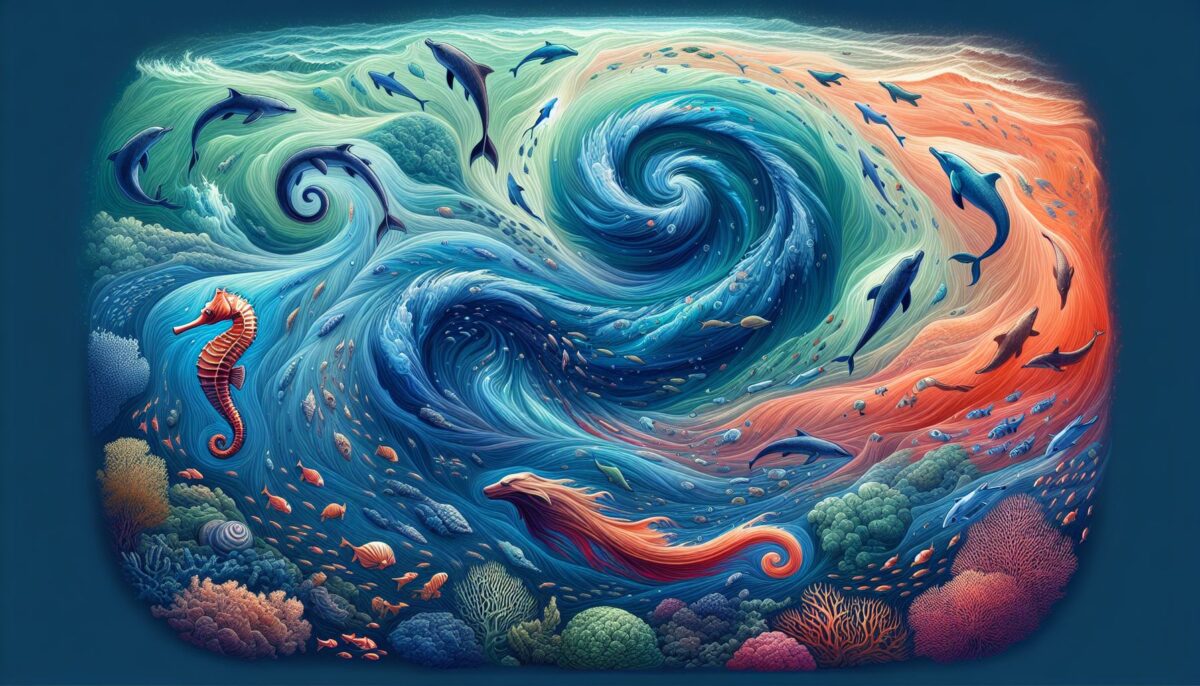
Ocean currents are like the Earth’s great circulatory system, moving vast amounts of water around the globe. They are critical in determining the climate of our planet, shaping marine life distribution, and influencing human activities. This article delves into the nature of ocean currents, exploring their causes, types, and their profound impact on the Earth and its inhabitants.
What Are Ocean Currents?
At its core, an ocean current is a continuous, directed movement of seawater generated by a number of forces acting upon the water, including wind, the Coriolis effect, gravitational pull from the moon, and differences in water density. These currents vary in size and speed, from large, permanent systems that span thousands of miles to smaller, more transient flows.
Causes of Ocean Currents
-
Wind: Wind blowing across the surface of the ocean pushes water to move in its direction, creating surface currents.
-
Earth’s Rotation: The Coriolis effect, resulting from the Earth’s rotation, causes currents to veer to the right in the Northern Hemisphere and to the left in the Southern Hemisphere.
-
Density Differences: Variations in water density due to differences in temperature and salinity can create currents. Warmer, less salty water tends to rise, while cooler, saltier water sinks, creating a movement known as thermohaline circulation.
-
Tides: The gravitational pull of the moon and sun on the Earth’s oceans can lead to tidal currents, which ebb and flow with the changing tides.
Types of Ocean Currents
Surface Currents
Surface currents, which make up about 10% of all the water in the ocean, are primarily driven by the wind. These currents typically extend down to about 400 meters and are most influential on the ocean’s surface. They can move at speeds of up to 5.6 km/h (3.5 mph) and are crucial for distributing heat from the equator towards the poles.
Deep Water Currents
These currents make up the other 90% of the ocean and are mostly driven by differences in water density, influenced by temperature and salinity. The most famous of these is the global conveyor belt, or thermohaline circulation, which can take a thousand years to complete one cycle.
The Role of Ocean Currents in Climate
Ocean currents play a pivotal role in the Earth’s climate. They transport warm water and precipitation from the equator towards the poles and cold water from the poles back towards the equator. This helps regulate and stabilize climate patterns. For instance:
-
The Gulf Stream: This warm Atlantic ocean current is responsible for the relatively mild climate in Northwestern Europe.
-
El Niño and La Niña: These are climate patterns in the Pacific Ocean that can cause global changes in weather patterns.
Marine Life and Ocean Currents
Marine organisms rely on currents for various aspects of their life, including:
-
Nutrient Delivery: Currents transport nutrients from the deep sea to coastal and surface waters, feeding plankton and supporting marine ecosystems.
-
Migration: Many species depend on ocean currents to travel to breeding grounds and feeding areas.
Human Interactions with Ocean Currents
-
Navigation: For centuries, sailors have used ocean currents to aid in sea navigation, making travel more efficient and saving valuable resources.
-
Fisheries: Currents bring nutrient-rich water to the surface, providing fertile fishing grounds.
-
Pollution Dispersion: Unfortunately, currents can also distribute pollutants and marine debris across the oceans.
The Changing Currents
Climate change and human activities can affect the delicate balance of ocean currents. For example, melting ice caps and glaciers due to global warming can freshen seawater and disrupt thermohaline circulation, potentially leading to dramatic shifts in climate patterns.
Protection and Study
Organizations and governments establish marine protected areas (MPAs) to safeguard critical regions affected by currents, and ongoing oceanographic research helps us understand and predict changes in oceanic systems.
Sources & Further Reading
- National Oceanic and Atmospheric Administration (NOAA) – What is an ocean current?
- National Geographic Society – Ocean Currents and Climate
- Intergovernmental Panel on Climate Change (IPCC) – Climate Change and Oceans
In conclusion, the study of ocean currents is more than an academic pursuit; it’s an attempt to understand a vital component of our planet’s life-support system. The intricate dance of warm and cold, salt and fresh, surface and deep waters across our global ocean shapes climates, feeds marine life, and impacts human activity in countless ways. As we continue to encounter new challenges presented by climate change and global-scale environmental issues, the importance of understanding and ethically interacting with ocean currents cannot be overstated. By protecting our oceans, we ultimately protect ourselves and ensure a sustainable future for generations to come.
