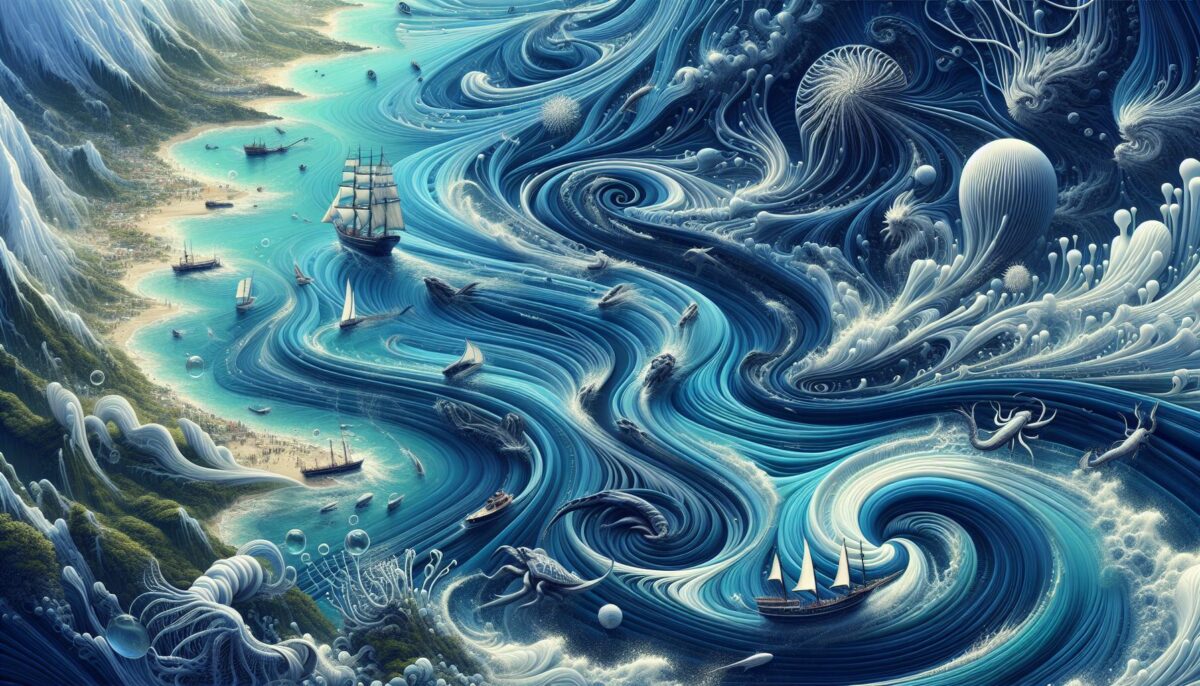
The planet’s oceans are not still bodies of water; they’re alive with motion, pulsating with currents that course through the vast basins like giant rivers within the sea. These currents play a critical role in shaping the climate, marine life distribution, and the very nature of our world’s water networks. Within the immense complexity of oceanography, the study of these currents is not just intriguing, it is vital for our understanding of Earth’s ecosystem and human impact on marine environments.
What are Ocean Currents?
Ocean currents are continuous, directed movements of seawater generated by a multitude of factors such as wind, water density differences, tides, and the Earth’s rotation. These currents can flow for thousands of kilometers and reach great depths, connecting the oceans of the world in a global circulation system that influences weather patterns, transports nutrients, and supports marine ecosystems.
Sources of Ocean Currents
Ocean currents are primarily driven by wind patterns and by the thermohaline circulation which stems from variations in water density:
-
Wind-Driven Currents: The surface currents, which make up about 10% of the water in the ocean, are mainly driven by the global wind patterns that arise due to the sun’s radiation and the Earth’s rotation. The Coriolis effect, a force resulting from the Earth’s rotation, deflects these winds to the right in the Northern Hemisphere and to the left in the Southern Hemisphere, shaping the currents accordingly.
-
Thermohaline Circulation: The deep-water currents, the other 90% of the ocean, are influenced by the water density, which is affected by temperature (thermo) and salinity (haline). Colder, saltier water is denser and sinks, driving a global pattern of deep-water movement that is also referred to as the “Global Conveyor Belt.”
Types of Ocean Currents
Ocean currents can be classified into several types, each characterized by specific features and effects:
-
Surface Currents: These are the upper 400 meters of the ocean and are mainly driven by wind. Famous ones include the Gulf Stream in the North Atlantic and the Kuroshio in the Pacific.
-
Deep Ocean Currents: Responsible for the large-scale exchange of water masses in the ocean depths, they’re slower moving, but incredibly voluminous.
-
Boundary Currents: These are currents that run along the boundaries of ocean basins, such as the East Australian Current.
-
Equatorial Currents: Run parallel to the equator and are unique as they are not heavily influenced by the Coriolis effect.
The Impact of Ocean Currents
Climate Regulation
Ocean currents govern the Earth’s climate by redistributing heat around the globe. Warm currents like the Gulf Stream transfer heat from the equatorial regions towards poles, moderating temperatures. Without these currents, regions at the same latitude would experience extreme temperatures, rendering them uninhabitable.
Marine Life
Nutrient-rich cold currents support marine biodiversity by bringing nutrients from the deep to the surface. This upwelling fuels phytoplankton growth, which forms the base of the marine food web. For example, the California Current supports a rich ecosystem and is crucial for the fishing industry.
Human Activities
Currents affect maritime activities, influencing navigation and shipping routes significantly. Historical explorations and modern shipping have relied on currents to save time and fuel. For instance, the Agulhas Current along the east coast of Africa is notorious for its strength and has played a significant role in navigation for centuries.
Challenges Posed by Ocean Currents
Navigation Hazards
Ocean currents can pose serious challenges to maritime navigation, resulting in shipwrecks and accidents. The variations in current flow can be unpredictable, especially in areas where currents converge or where there is a sudden change in depth or coastline.
Impact on Climate
Changes in ocean currents can drastically affect the climate. An alteration in the thermohilane circulation could lead to significant cooling or warming in various parts of the world. For instance, a slowdown of the Gulf Stream could lead to colder weather in Europe.
Marine Pollution Dispersion
Currents are responsible for the transport of pollutants and marine debris, spreading them across vast areas. The Great Pacific Garbage Patch, for example, is held in place by ocean currents known as the North Pacific Gyre.
Conservation and Sustainable Use
Understanding ocean currents is not only important for economic and navigational purposes but also for environmental conservation. Here are some ways that research into currents is being used for sustainable practices:
-
Marine Protected Areas (MPAs): MPAs benefit from studies on current patterns to help manage fisheries and safeguard vulnerable ecosystems.
-
Oil Spill Response: Knowledge of currents is critical in predicting the movement of oil spills, which is essential for executing efficient response and cleanup operations.
-
Renewable Energy: Tidal and ocean current energy offer potential renewable energy sources, with currents driving turbines for electricity generation.
-
Climate Change Research: Studying changes in ocean currents helps scientists understand the effects of climate change on global systems.
Conclusion
Ocean currents represent one of the most dynamic and powerful systems on the planet, affecting everything from climate to marine life distribution to human activities. As our understanding of these pathways of the seas grows, so too does our ability to harness their power for the benefit of the global ecosystem and human civilization.
Sources
- National Oceanic and Atmospheric Administration (NOAA) – Ocean Currents
- Intergovernmental Oceanographic Commission – The Role of Ocean Currents in Climate
- United Nations Environment Programme – Marine and Coastal Ecosystems
Understanding the dynamics of ocean currents is not just an academic exercise but a necessity to confront the challenges of an ever-changing planet. As we continue to explore the depths of our oceans and harness their currents, we must do so responsibly, ensuring the health and sustainability of our global marine environment for generations to come.
