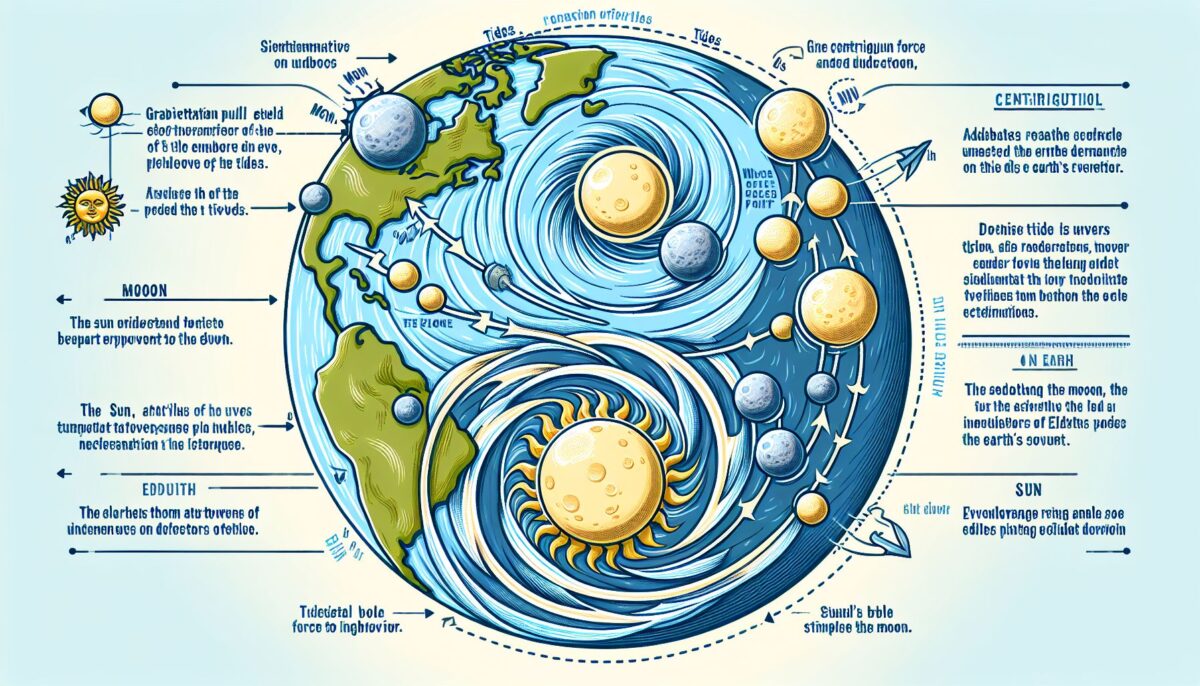
Tides are one of the most reliable phenomena in the world. As you stand on the shore, watching the water edge closer and then retreat with rhythmic certainty, it’s easy to take this natural cycle for granted. However, the forces that govern tides are a complex interplay of celestial mechanics, oceanography, and Earth’s own features. This article delves into the intricate world of tides—how they work, their types and characteristics, their impact on human activity and the environment, and the future of tidal research.
The Mechanism Behind Tides
Tides are the long-period waves that roll around the planet as the ocean is “pulled,” creating a bulge, by the gravitational interaction with the moon and, to a lesser extent, the sun. When we talk about the rise and fall of sea level, we are essentially discussing the movement of these bulges across the ocean’s surface.
Gravitational Pull and Tidal Forces
The physics of tides is intertwined with the gravitational pull of the moon and the sun. The moon, being closer to the Earth, exerts a more substantial pull on our planet’s water. The water facing the moon gets pulled toward it, forming what is called the ‘tidal bulge.’ On the opposite side of the Earth, there’s another bulge, due to the centrifugal force of Earth-moon rotation. These two opposing forces create what is known as high tide.
Between these bulges are the areas of lower water levels, or low tides. As the Earth rotates, any given point on the Earth’s surface passes through both of these bulges each day, which gives most coastal areas two high and two low tides per solar day—a cycle known as semidiurnal tides.
Spring and Neap Tides
The relative positions of the Earth, moon, and sun influence the strength and height of tides. When the Earth, moon, and sun are all in a line (during the full moon and new moon phases), the gravitational forces combine to produce the highest and lowest tides, called spring tides. Conversely, when the moon is at a right angle to the Earth-sun line (during the first and last quarter phases of the moon), the solar tidal force partially cancels out the moon’s tidal force, resulting in neap tides, which are less extreme.
Types of Tides and Tidal Patterns
Tidal patterns vary from one geographic location to another. Some places experience one high and one low tide per day, known as diurnal tides. Other locations might have semidiurnal tides or mixed tides where the difference in height between successive high and low tides varies significantly.
Tidal Ranges and Anomalies
The difference in height between the high tide and the low tide is known as the tidal range. Tidal ranges can be dramatically different around the world. Large tidal ranges can be found in areas with extensive coastlines or where the continental shelf is broad and shallow, such as the Bay of Fundy in Canada, which boasts the highest tides in the world.
Tidal anomalies, such as tidal bores—large waves that travel up rivers from the coast as a result of certain high tides—add to the complexity of tidal behavior and have inspired both awe and scientific curiosity throughout history.
The Impact of Tides on Human Activity
Tides have a considerable influence on human activities, including navigation, fishing, and the operation of ports and harbors. They also play a powerful role in maritime trade and how we harness renewable energy sources.
Navigation and Shipping
Mariners have to take into account the state of tides to ensure safe passage. Knowledge of tides is crucial for navigating shallow waters or entering and leaving ports and harbors to avoid running aground.
Tidal Energy
As a source of renewable energy, tides are predictable and more reliable than wind or solar power. Tidal energy can be harnessed through the movement of water during changes in tidal range, using turbines or through the capture of kinetic energy from the flow of water.
Future of Tidal Research
While tidal patterns are well-documented and predictable, there is still much to learn. Future tidal research may focus on the impact of climate change on tidal patterns, as changes in sea level can alter the relationship between the Earth and the moon, potentially affecting the strength and timing of tides.
Rising Sea Levels and Tides
Global warming and the resulting rise in sea levels pose a significant threat to tidal stability. As the ocean’s volume increases, the distribution of tidal forces could shift, leading to stronger or more erratic tides, which can have far-reaching ecological and socioeconomic consequences.
Technological Advances in Tidal Studies
With advances in technology, such as satellite altimetry, oceanographers are better equipped to study and predict tidal movements than ever before. New models can incorporate complex variables such as the ocean floor’s topography and changes in water density.
Conclusion
The dance of the tides is a captivating natural occurrence sculpted by the gravitational forces of our moon and sun, the rotation of our planet, geographical anomalies, and the depth of the oceans. As we increase our understanding of this phenomenon, we also increase our ability to interact with our planet more harmoniously, utilizing the power of the tides without detrimental effects on marine life and coastal ecosystems.
Ongoing research and the careful management of our coastal and ocean resources can help us respect the oceans’ ebb and flow in the face of changing climate conditions and preserve the sea’s majestic tides for future generations.
Sources
- The National Oceanic and Atmospheric Administration (NOAA) – Tides and Currents: https://tidesandcurrents.noaa.gov/
- The U.S. Geological Survey – The Water Cycle: Tides: https://www.usgs.gov/special-topic/water-science-school/science/tides-and-water-levels
- International Renewable Energy Agency – Tidal Energy: https://www.irena.org/ocean
