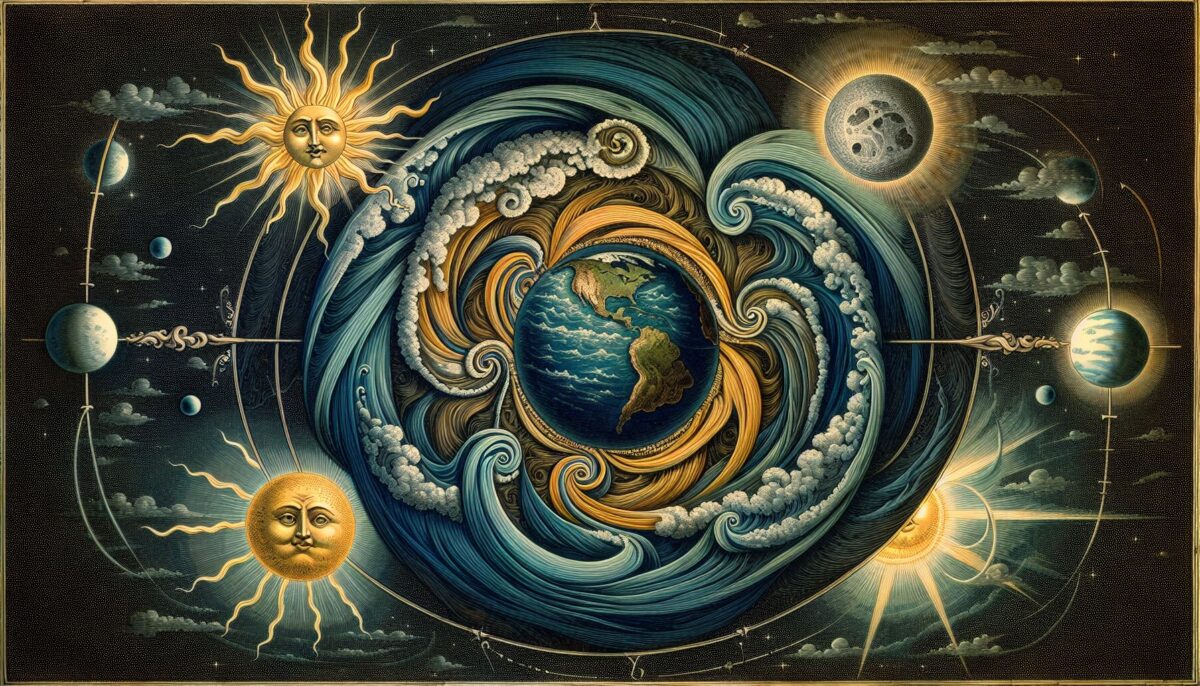
Tides are an extraordinary phenomenon that occur as the very fabric of our oceans dances to the gravitational pull of the moon and sun, in partnership with Earth’s own rotation. From ancient mariners who have charted their courses around these rhythmic movements to modern scientists seeking to understand their broader implications, tides hold an important place in our understanding of the Earth’s natural systems. In this deep dive into the world of tides, we will explore their origins, their impact on marine life and human activity, and the incredible forces at play in creating these daily movements of the sea.
The Mechanics of Tides: A Celestial Symphony
At the heart of tides lies the gravitational interaction between Earth, the moon, and the sun. While the moon is much smaller than the sun, its proximity to Earth means that its gravitational effects are more pronounced, making it the primary player in the tidal dance.
Gravitational Pull and Tidal Forces
Earth’s waters respond to the gravitational pull from the moon, creating a bulge of water on the side closest to the moon. This is what we know as the high tide. There is also a corresponding high tide on the opposite side of the Earth, created by the inertial force of Earth’s rotation, which essentially flings the water outward.
The sun also plays a role but to a lesser extent. When the sun, moon, and Earth align during full and new moons, we experience spring tides — not a reference to the season, but the “springing forth” of the water. Conversely, when the sun and moon are at right angles relative to Earth, their gravitational forces partially cancel each other out, resulting in weaker neap tides.
The Changing Seasons and Tides
Tidal ranges can also be influenced by Earth’s axial tilt and orbit around the sun. During different seasons, the sun’s position changes, altering its gravitational impact on Earth’s waters. During equinoxes, for instance, the sun is directly over the equator, leading to enhanced tidal effects worldwide.
The Ebb and Flow: Types of Tides and Their Frequencies
The Earth experiences two main types of tides: semidiurnal, with two high and two low tides each day, and diurnal, with one high and one low tide per day. The type and occurrence of tides depend greatly on one’s geographical location and the configuration of the local coastline and seafloor.
Semidiurnal Tides
Most coastal areas around the world experience semidiurnal tides, including the Atlantic coast of Europe and North America. In these regions, the two high and two low tides are approximately of the same height.
Diurnal Tides
Diurnal tides are less common and can be found in places like the Gulf of Mexico and the South China Sea. These regions often have a more pronounced high or low tide once each day.
Mixed Tides
In addition to the main types, there are also mixed tides, which exhibit characteristics of both diurnal and semidiurnal tides. These can be observed on the Pacific coast of North America, where the difference in height between successive high and low tides—known as the “diurnal inequality”—is often marked.
Impact on Marine Life
Tides orchestrate the rhythm of life in marine environments. Intertidal zones—the areas between high and low tide marks—are bustling ecosystems that depend on the cyclical nature of tides.
Tidal Pools and Ecosystems
Tidal pools are microcosms of marine biodiversity, where organisms have adapted to the changing conditions. These pools offer a stable environment during low tide for species including starfish, sea urchins, and various mollusks.
Breeding and Feeding Cycles
Many marine species have synchronized their breeding cycles with the tides. For example, the reproductive activities of grunion, a small silver fish found off the coast of California, are timed precisely with the high tides of spring and summer to protect their eggs buried in the sand.
Tides and Human Activity: From Ancient Navigation to Modern Challenges
Navigators of the past relied heavily on tidal patterns to ensure safe passages for their vessels. Understanding the timing and magnitude of tides was, and still remains, essential for everything from small-scale fishing operations to international shipping.
Ports and Shipping
Ports around the world are designed with tidal considerations in mind. Harbor entrances need to accommodate the tidal fluctuations that can significantly alter water depths. Furthermore, shipping schedules often hinge on the prediction of tides to avoid the risk of running aground.
Renewable Energy and Tides
The potential for tidal energy is immense. Tidal turbines, much like underwater windmills, can harness the kinetic energy of tides to produce electricity. Projects such as the Sihwa Lake Tidal Power Station in South Korea and the Rance Tidal Power Station in France have shown the world the renewable potential locked in tidal movements.
Coastal Management and Tidal Predictions
As climate change and sea level rise become more pressing, accurate tidal predictions are essential for coastal management and engineering. From building sea defenses to planning for storm surges, understanding tides is critical for protecting coastal communities.
Unveiling the Mysteries of Tides
The study of tides falls within the scope of oceanography and specifically tidal hydrodynamics. Advanced computational models are used to predict tides, taking into account factors such as the positions of celestial bodies, the shape of coastlines, and the depth of the ocean floor.
Progressive Waves and Standing Waves
Tides can manifest as progressive waves, which travel around ocean basins, or as standing waves, which are the result of water moving between constraining boundaries such as those in bays or estuaries.
Tidal Harmonic Analysis
Harmonic analysis is a mathematical method used to predict tides by analyzing the periodic motion of tidal constituents—the individual sine waves that combine to form the tidal signal.
The Future of Tidal Research
As technology and data collection methods improve, our understanding of tides continues to evolve. Satellites like the European Space Agency’s Sentinel-3 are proving invaluable in monitoring the oceans and providing data for tidal models. Ongoing research is also focused on exploring the deeper impacts of tides on global climate dynamics and the Earth’s rotation.
Conclusion
Tides are more than just the gentle rise and fall of the sea. They are an essential part of Earth’s natural systems, influencing marine ecosystems, human activities, and the planet’s climate. By studying tides, we can gain insights into the Earth’s history, present challenges, and future possibilities in harnessing clean energy. As we continue to depend on the oceans for sustenance, transport, and recreation, the timeless rhythm of the tides remains a reminder of the dynamic and interconnected world in which we live.
Sources
- “Tides and Water Levels” – NOAA’s National Ocean Service (oceanservice.noaa.gov)
- “Tidal Energy” – Office of Energy Efficiency & Renewable Energy (energy.gov)
- “
