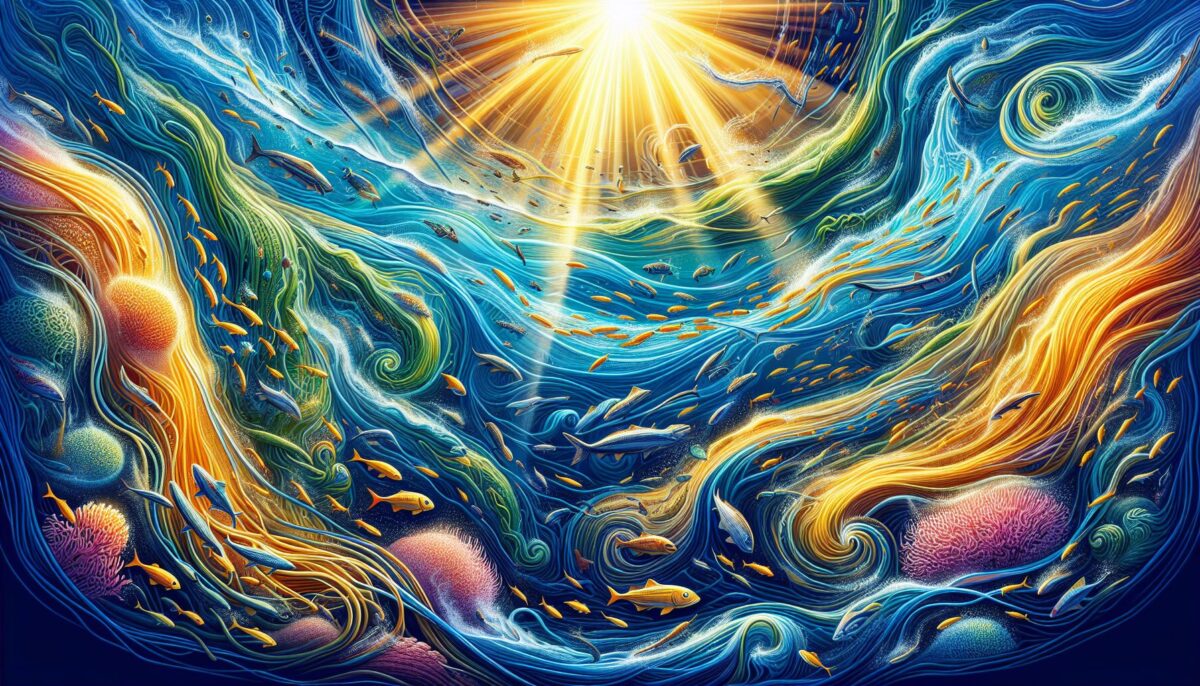
Ocean currents are a part of nature’s grand design, playing a colossal role in determining the climate and helping life to proliferate. These undulating, unseen giants set the rhythms of the ocean, directing nutrients, influencing climate, and even serving as underwater pathways for marine species. So, let’s delve into the world of these streams, their formation, their impact on our climate and marine life, and their influence on human activities.
1. Understanding Ocean Currents
Ocean currents can be broadly classified into two categories: surface currents which constitute roughly 10% of the water in the ocean and occur above the pycnocline (the ocean’s vertical thermocline division), and deep water currents, also referred to as Thermohaline Currents, which comprise the remaining 90%.
Surface Currents are primarily driven by the winds. The pattern they adopt is not simply identical to the wind direction, though. The Coriolis Effect, caused by the Earth’s rotation, bends the path of these currents to the right in the Northern Hemisphere and to the left in the Southern Hemisphere. This phenomenon leads to circular patterns called gyres.
Deep Water Currents work differently. They are initiated by the density differences in water masses because of variations in temperature (thermo) and salinity (haline). This circulating pattern is known as Thermohaline Circulation.
2. The Role of Ocean Currents in Climate Regulation
The ocean currents also serve as a sprawling conveyor belt, transporting heat from the tropics to the poles. For instance, the Gulf Stream, a well-known current, moves warm water from the Gulf of Mexico towards the North Atlantic, making Western Europe’s climate significantly warmer than it would be otherwise.
Another instance is El Niño and La Niña phenomena. These refer to fluctuations in the temperature of surface waters in the Equatorial Pacific, which significantly affect weather patterns globally.
3. Ocean Currents and Marine Life
Far from being barren, the open ocean is home to a wealth of marine life. With both food and predators in short supply, survival for many of these creatures depends on the ocean currents. Currents can carry nutrients from the deep sea to the surface, triggering phytoplankton blooms that form the basis of the oceanic food web, encouraging rich and diverse marine communities to flourish. For example, in upwelling areas like the California Current System, where deep, nutrient-rich waters reach the surface, they host ample fish stock and serve as prime fishing grounds.
4. Ocean Currents and Human Activities
From navigation to climate change, ocean currents have a direct impact on human activities. For centuries, mariners have relied on currents, using them as highways on the sea. In modern days, with the advancement of technology, data about ocean currents aids the design and operations of offshore enterprises like marine renewable energy, oil and gas extraction, and aquaculture.
Furthermore, currents have a profound influence on the spread of contaminants in the instances of oil spills and other pollutants. Understanding the pattern of ocean currents is critical for emergency response in case of such environmental disasters.
5. The Threat of Global Warming on Ocean Currents
Global warming poses a threat to the delicate balance of ocean currents. There is concern that melting Arctic ice due to increasing global temperature may disrupt the Atlantic Meridional Overturning Circulation (AMOC), potentially leading to drastic climate change in Europe and North America.
Conclusion
The dance of the ocean currents remains one of the most robust yet delicate systems on the planet. From regulating our climate to shaping marine biodiversity, their unseen contributions are immense. As stewards of this blue planet, we ought to expand our knowledge and deepen our understanding of these currents, to safeguard the oceans and, by extension, the life on Earth.
References
-
NOAA – National Oceanic and Atmospheric Administration – Ocean Currents
-
Britannica – Gulf Stream
-
NOAA’s National Ocean Service – California Current System
