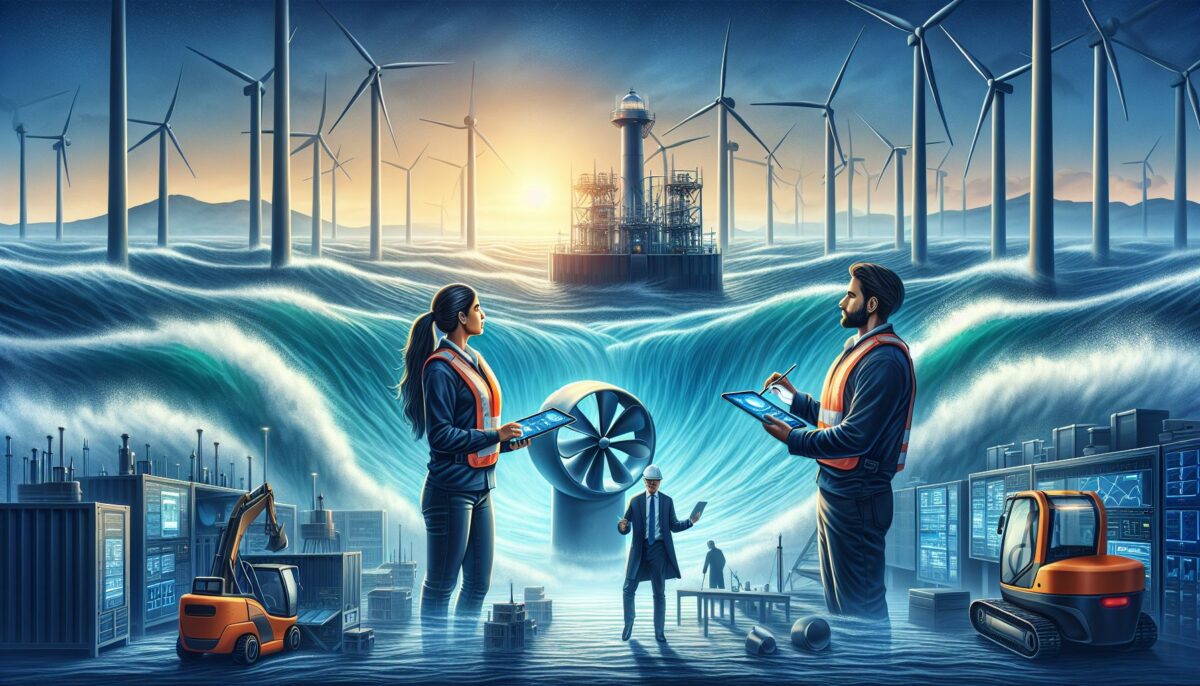
Marine renewable energy is rapidly emerging as a pivotal sector in the blue economy’s landscape, providing a sustainable and eco-friendly alternative to our traditional energy sources. Among the various forms of marine energy, tidal and wave power stand out as promising contenders, harnessing the immense and consistent energy produced by the natural movements of our oceans. In this comprehensive article, we dive into the fascinating world of tidal and wave energy, exploring the science behind these technologies, their potential, challenges, benefits, and the future they hold for a sustainable planet.
The Science of Tides and Waves
To fully understand how we can extract energy from the ocean, we must first delve into the science of tides and waves.
Tides: The Rhythmic Pulse of the Ocean
Tides are the long-period waves that move through the oceans in response to the gravitational pull of the moon and the sun. The vertical movement of the tides, affected by the geographical configurations of coastlines, leads to the periodic rise and fall of sea levels known as high tide and low tide.
Waves: Ocean’s Energy in Motion
Waves, on the other hand, are generated primarily by wind as it blows across the surface of the sea. The energy is transferred from the air to the water, creating the oscillating patterns we recognize as waves. This energy is influenced by wind speed, duration, and the distance over which the wind blows, known as the fetch.
Harnessing Tidal Energy
Tidal energy is captured through the movement of water caused by the tides. There are three primary methods of generating electricity from tidal movements:
- Tidal Streams: Devices similar to wind turbines are placed in fast-flowing tidal areas. The movement of the water turns the turbines, generating electricity.
- Tidal Barrages: Barrages are built across estuaries with a significant tidal range. As the tide moves in and out, water flows through turbines in the barrage, producing power.
- Tidal Lagoons: Enclosed off sections of the coast create an artificial lagoon, which can be used similarly to barrages but with potentially less environmental impact.
How Effective Are Tidal Power Stations?
The world’s first large-scale tidal power plant, La Rance Tidal Power Station in France, has been operational since 1966 and remains one of the most significant examples of tidal energy production. Developments in the UK, South Korea, and Canada continue to showcase tidal power’s massive potential.
Wave Energy: Ocean’s Untamed Force
Wave energy conversion devices capture the physical movement of waves and convert it into usable power. There are various wave energy devices, ranging from point absorbers, which move with the waves to generate electricity, to oscillating water columns and overtopping devices.
Innovative Wave Energy Converters
One of the most innovative wave energy converters is the point absorber buoy. It floats on the water’s surface and moves with the waves. This motion drives a generator inside the buoy, creating electricity. Companies like Pelamis Wave Power and Ocean Power Technologies are pioneering this field with their cutting-edge designs.
Environmental and Economic Benefits
Tidal and wave energy present several significant benefits:
-
Renewable Resource: The ocean’s movements are endless, making tide and wave energy infinitely renewable.
-
Environmentally Friendly: Unlike fossil fuels, tidal and wave energy produce no greenhouse gases or other pollutants.
-
Predictability: Tides are highly predictable, allowing for better grid management.
-
Job Creation: The burgeoning industry creates jobs in coastal regions.
-
Energy Security: Marine energy offers energy independence for coastal countries.
Challenges and Considerations
Despite the benefits, tidal and wave energy developments face challenges.
-
High Initial Costs: The cost of developing marine energy infrastructure can be significant, although costs are expected to decrease as technology advances.
-
Environmental Impact: There is concern about potential impacts on marine life and ecosystems.
-
Technical Hurdles: As relatively new technologies, wave and tidal energy systems are still evolving, and technical challenges must be overcome to maximize efficiency and durability.
-
Grid Integration: Integrating this intermittent energy source into the national power grid remains a technical challenge.
What’s on the Horizon?
Advancements in material science, engineering, and biotechnology are paving the way for second-generation tidal and wave energy converters that are more efficient, durable, and less invasive to marine environments.
Innovative Approaches to Harvesting Marine Energy
-
Researchers are exploring biomimicry, designing turbines and converters based on the movements of marine animals to improve efficiency.
-
Advances in computer modeling help identify optimal locations for wave and tidal energy farms.
-
Better energy storage solutions are being developed to store surplus energy generated during peak production times.
Case Studies and Examples
Around the world, several projects exemplify the potential of tidal and wave energy:
-
Sihwa Lake Tidal Power Station, South Korea: The world’s largest tidal power installation, generating over 250 MW.
-
Orkney Islands, Scotland: Home to the European Marine Energy Centre (EMEC), leading the research and development of wave and tidal energy.
-
MeyGen Project, Scotland: The first large-scale tidal stream project aiming to deliver enough energy to power 175,000 homes.
The Role of Policy and Investment
Effective policies and investment are crucial to the growth of the tidal and wave energy sectors.
-
Incentives and Subsidies: Similar to wind and solar, governments can provide financial support to help the industry scale.
-
International Collaboration: Sharing research, best practices, and resources is essential for global development of marine energy.
-
Investment in Infrastructure: Modernizing ports and grids to accommodate marine energy technologies is a must.
Conclusion: The Tide is Turning
The potential for tidal and wave energy to contribute significantly to our clean energy future is immense. With continued innovation, collaboration, and supportive policies, we can look forward to a time where the world’s coastlines are powered by the very seas that surround them.
Sources
- European Marine Energy Centre (EMEC): http://www.emec.org.uk/
- International Renewable Energy Agency (IRENA): https://www.irena.org/
- Ocean Energy Systems (OES): https://www.ocean-energy-systems.org/
The information presented in this article is accurate as of the knowledge cutoff in March 2023.
